In This Article
What Is the Series 65 and Who Needs It?
The Series 65 (Uniform Investment Adviser Law Exam) is administered by FINRA and required by most US states for registration as an Investment Adviser Representative (IAR). If you want to charge fees for investment advice — as a financial planner, investment adviser, or portfolio manager — you almost certainly need to pass this exam.
Unlike the Series 7, the Series 65 does not require firm sponsorship. You can register through FINRA's system independently. This makes it the standard first step for independent advisers and fee-only financial planners.
The 4 Exam Domains and Their Weights
Domain 1: Economic Factors and Business Information (15%) — Business cycles, monetary policy, fiscal policy, economic indicators, and how macroeconomic conditions affect investment decisions and portfolio management.
Domain 2: Investment Vehicle Characteristics (25%) — Equity securities, debt instruments, municipal bonds, derivatives, mutual funds, ETFs, variable products, REITs, and alternative investments. You need to know how each works and how the exam tests its characteristics.
Domain 3: Client Investment Recommendations and Strategies (30%) — The largest domain. Portfolio theory (MPT, CAPM, efficient frontier), asset allocation, risk tolerance assessment, tax considerations, retirement planning strategies, and suitability.
Domain 4: Laws, Regulations, and Guidelines (30%) — Tied with Domain 3 as the largest section. The Uniform Securities Act, Investment Advisers Act of 1940, fiduciary duty, prohibited practices, registration requirements, and state-level regulation specific to investment advisers.
Scoring and Pass Rates
The Series 65 exam contains 130 scored questions (140 total, with 10 unscored pretest questions). You have 3 hours to complete it. You need to answer at least 94 questions correctly (72%) to pass.
Pass rates are approximately 65-70% for first-time candidates. The combination of a high passing score (72%) and the breadth of the laws and regulations domain makes this a genuinely challenging exam.
The Hardest Topics on the Series 65
Based on candidate feedback, these are the most frequently missed areas:
- The Uniform Securities Act: The registration requirements for investment advisers vs. broker-dealers, exemptions from registration, and the specific circumstances that trigger state vs. federal jurisdiction are confusing and heavily tested.
- Fiduciary duty: The specific obligations of a fiduciary adviser, how they differ from the broker-dealer suitability standard, and the nuances of disclosure requirements.
- Portfolio theory calculations: Standard deviation, beta, Sharpe ratio, and alpha appear on the exam in both conceptual and calculation form. Many candidates are rusty on the math.
- Derivative characteristics: Options, futures, and how they are used in portfolio management are tested more deeply than most candidates expect.
A 6-Week Study Plan
Week 1: Domain 2 — Investment Vehicle Characteristics. Know how each security type works, its risk profile, and how it is taxed.
Week 2: Domain 1 — Economics. This is the most conceptual section. Focus on how interest rates affect different asset classes and how to interpret economic indicators.
Week 3-4: Domain 3 — Client Recommendations and Strategies. This is the heaviest content section. Portfolio theory, suitability, and retirement planning each deserve dedicated sessions.
Week 5: Domain 4 — Laws and Regulations. Read through the Uniform Securities Act framework carefully. Know the registration requirements and exemptions cold.
Week 6: Full practice exams under timed conditions. Review every wrong answer. Focus remaining time on your weakest domain.
Series 65 vs. Series 66: Which Do You Need?
If you already hold a Series 7 license, you take the Series 66 (not the Series 65). The Series 66 is a shorter combined exam that covers the same content as the Series 65 plus the Series 63.
If you do not hold a Series 7, you take the Series 65. This is the case for most independent RIA professionals, fee-only financial planners, and anyone who does not sell securities products through a broker-dealer.
Some states accept a CFA, CFP, ChFC, CLU, CPA, or PFS designation in lieu of the Series 65. Check your state's specific requirements before registering.
Best Study Resources
Effective Series 65 preparation combines conceptual understanding with heavy practice question exposure. The laws and regulations domain in particular requires repeated exposure to the Uniform Securities Act in different question formats before the nuances become clear.
Look for study resources that include at least 300-400 practice questions with detailed explanations, cover Domain 4 in depth, and provide a way to track your performance by domain so you can identify and address weak areas efficiently.
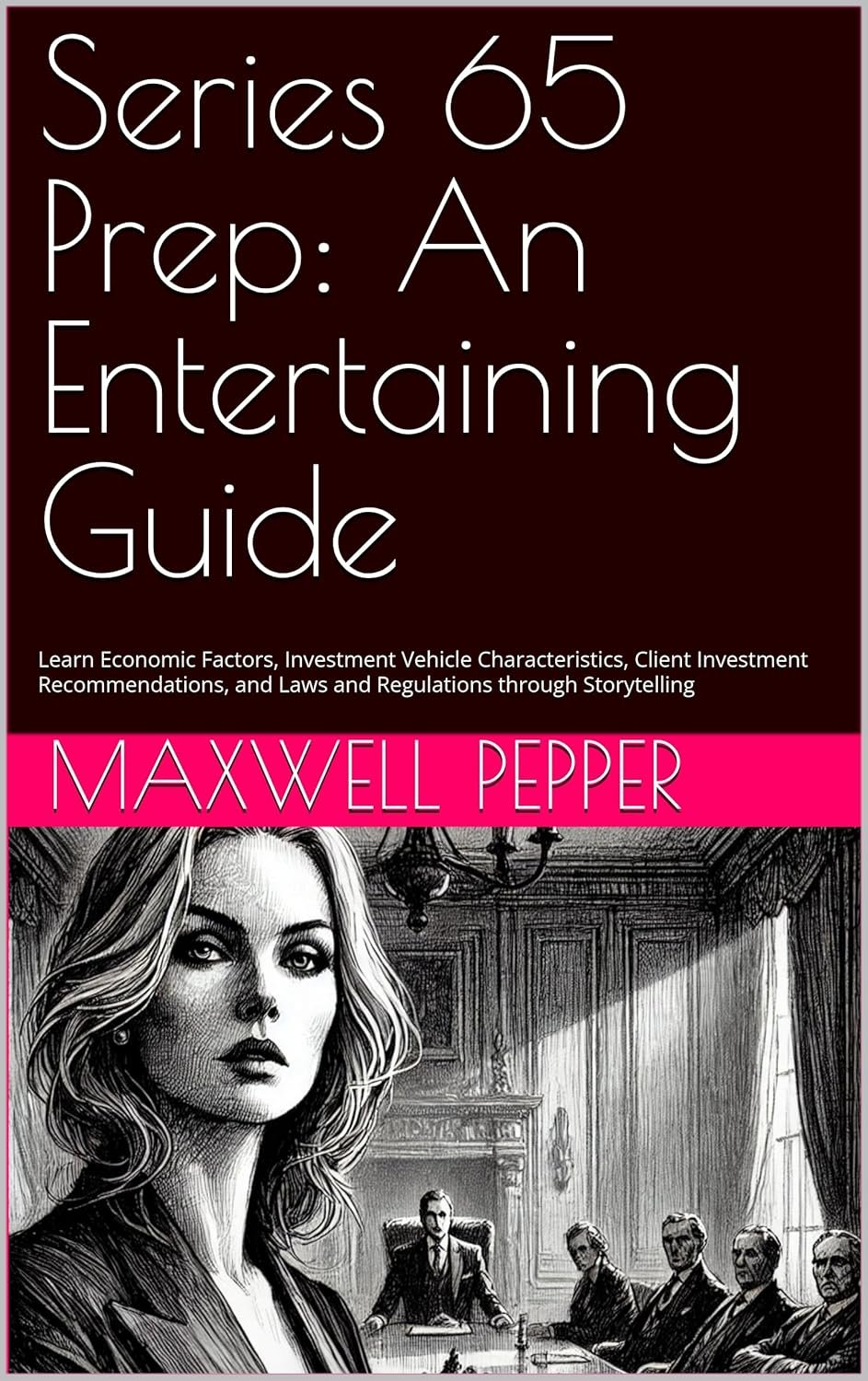
Series 65 Prep: An Entertaining Guide — Learn Through Storytelling
Maxwell Pepper's Series 65 guide follows Harold through real advisory situations that teach every exam concept. The most engaging Series 65 prep available.
Get It on Amazon ↗
Maxwell Pepper is a licensed Professional Engineer (PE), Project Management Professional (PMP), and MBA with 15+ years of experience in the energy industry. He lives in Houston, Texas.
Browse all Maxwell Pepper books →