In This Article
What the FAA Part 107 Exam Tests
The FAA Part 107 Knowledge Test is required for anyone who wants to fly drones commercially in the United States. It tests your understanding of the rules, airspace, and operational requirements that apply to unmanned aircraft systems (UAS) weighing under 55 pounds.
The exam contains 60 multiple-choice questions. You have 2 hours to complete it and need to answer at least 42 correctly (70%) to pass. It is administered at PSI/CATS testing centers nationwide for a $175 fee.
The 7 Knowledge Areas and What to Focus On
The FAA tests across these knowledge areas:
- Applicable regulations: Part 107 rules, waivers, Remote ID
- Airspace classification: Classes A-G, special use airspace, TFRs
- Aviation weather: METARs, TAFs, winds aloft, density altitude
- Loading and performance: Weight, balance, and performance limitations
- Emergency procedures: What to do when operations go wrong
- Crew resource management: Decision-making and crew coordination
- Radio communications: ATC communication basics near airports
Airspace and weather together account for roughly 40-50% of exam questions. These are the two most technical sections and where most candidates lose the most points.
Pass Rates and What Trips Candidates Up
The Part 107 exam has a pass rate around 80% for well-prepared candidates. Most failures come from two areas:
- Airspace sectional chart reading. Knowing how to interpret the concentric circles, magenta vs. blue airports, and ceiling/floor notations on a sectional chart is tested heavily and trips up candidates who try to memorize rules without learning to read the charts.
- Weather interpretation. Reading a METAR or TAF under time pressure is a skill that needs practice. Many candidates know what a METAR looks like but cannot decode it quickly enough during the exam.
A 2-Week Study Plan
Days 1-3: Read through FAA regulations — specifically 14 CFR Part 107. Know the operational limitations (altitude, speed, visibility, daytime, distance from airports) cold.
Days 4-6: Airspace. Study the sectional chart legend. Practice identifying airspace classes and their ceiling/floor values. Use the free FAA practice charts.
Days 7-9: Weather. Learn to decode METARs and TAFs. Practice with real examples. Study density altitude and its effect on performance.
Days 10-12: Loading, performance, emergency procedures, and radio communications. These are smaller sections but worth covering.
Days 13-14: Full practice tests. Review every wrong answer. Focus additional time on your weakest sections.
Airspace Questions: The Hardest Section Explained
Airspace questions ask you to look at a sectional chart excerpt and determine: what class of airspace is a given location in, what altitude is the floor/ceiling, and whether authorization is required to fly there.
Key things to know cold for the exam:
- Class B: solid blue lines, typically major airports, requires specific ATC authorization
- Class C: solid magenta lines, typically medium airports, requires ATC communication
- Class D: dashed blue lines, typically smaller towered airports, requires communication
- Class E: starts at 700 AGL (magenta shading) or 1200 AGL (no shading), or 14,500 MSL
- Class G: uncontrolled airspace, no authorization required
- LAANC authorization is required for Class B, C, D, and E airspace within the airport's radius
Weather Questions: How to Read METARs and TAFs
A METAR is an hourly weather observation. A TAF is a weather forecast. Both appear on the Part 107 exam. Here is a quick METAR example:
METAR KORD 051552Z 27018KT 10SM FEW025 BKN080 22/10 A2992
Breaking it down: KORD (Chicago O'Hare), 05th at 1552Z (UTC), wind 270° at 18 knots, 10 statute miles visibility, few clouds at 2,500 feet, broken clouds at 8,000 feet, temperature 22°C / dewpoint 10°C, altimeter 29.92.
For Part 107 purposes, focus on: visibility (must be 3 SM minimum), ceiling (must be at least 500 feet below clouds), wind speed, and temperature/dewpoint spread (small spread = higher fog risk).
Where to Take the Exam and What to Expect
Register at the PSI Exams website (psiexams.com) or through CATS (1800contacts.com). Testing centers are located in most major cities. Bring a government-issued photo ID. No scratch paper is provided, but you can request a whiteboard marker and board at most locations.
Results appear immediately on screen after you finish. If you pass, your Temporary Remote Pilot Certificate is issued by the FAA within 10 days via IACRA.
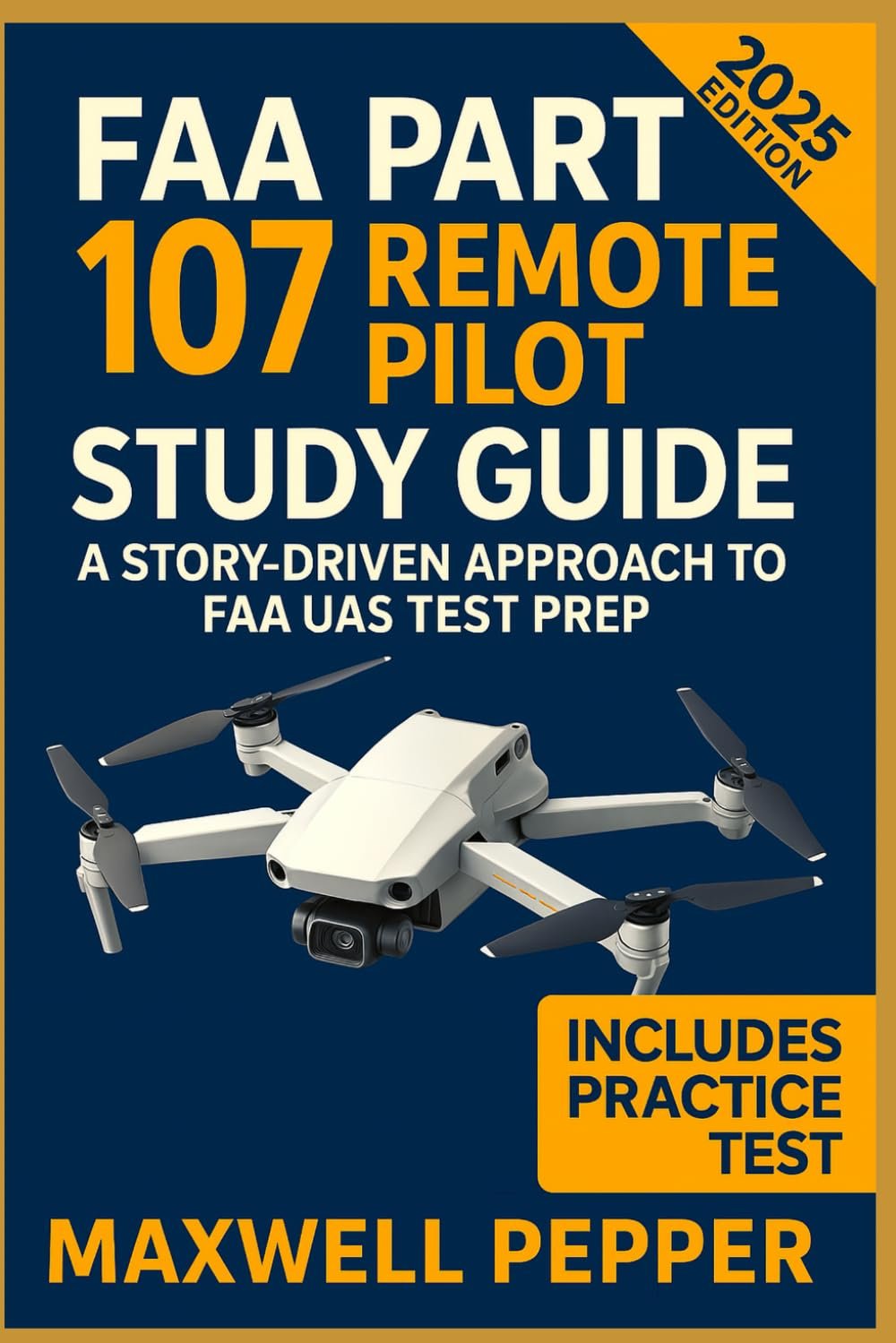
FAA Part 107 Remote Pilot Study Guide — 2025 Edition
Maxwell Pepper's story-driven FAA Part 107 guide follows Viper through real flight missions that teach every knowledge area the FAA tests. Includes a full practice test.
Get It on Amazon ↗
Maxwell Pepper is a licensed Professional Engineer (PE), Project Management Professional (PMP), and MBA with 15+ years of experience in the energy industry. He lives in Houston, Texas.
Browse all Maxwell Pepper books →